The European Union finds itself in a strategic dilemma. Whilst the United States and China have long been merging civilian innovation with military capabilities to dominate global competition, Europe remains trapped by its own regulatory dilemmas regarding dual-use technologies. Caught between the need to protect economic security and the risk of stifling the single market competitiveness, the EU is called upon to make a change. From the funding deadlock to strict export controls, the EU needs to overcome its flaws to avoid succumbing in the new technological arms race.
Disclaimer
Dual-use technologies have become a focal point in the global governance debate (Kremidas-Courtney, 2025). The United States (U.S.) has been in the dual-use business for decades, while China engaged very strongly by fusing civilian and military research and innovation (R&I). On one side, the United States has benefited from a first-mover advantage since the second half of the 20th century, through defence research and spending, becoming the leader in the IT sector and semiconductor design; on the other side, China, amid great-power competition (Goddard, 2025), has invested heavily in its military, dual-use technologies, and industry through initiatives such as Made in China 2025 or its military-civil fusion policy (MCF) (Teer & Spatafora, 2025; Steinberg & Wolff, 2023). Within this context, the EU has put in place initiatives to leverage the potential of dual-use technologies to maintain its competitive edge.
Many daily use technologies were conceived as defence-sector research projects (European Commission, 2017). Over the last 50 years, however, the balance of innovation has shifted from military-led to civilian-led (Francica, 2025). This reflects the end of the Cold War and a decrease in military spending, but also faster cycles and major investments in the civil sector. As this trend reverses, different defence-related opportunities, as well as shortcomings, emerge (European Commission, 2017; European Commission, 2024b). European R&I concentrates mostly on civilian innovations, while projects with military purposes are excluded and dual-use is permitted in limited and/or indirect forms (Cutts, 2025). However, due to the current geopolitical context, having both civil and military defence applications is the objective. This is achieved through increased defence spending and investments in potential breakthroughs that lie in the intersection of civilian and military applications. The need for effective structures that facilitate the transfer of knowledge from civilian to military applications has increased, since civilian sectors drive innovation (Singer et al., 2025).
Since great power competition means that technologies are no longer neutral and risks rise, the EU must guarantee its (economic) security both as a defensive shield and a strategic necessity (Goddard, 2025). Thus, after four decades of predominantly civilian-oriented R&I in the EU, change is necessary. Europe needs to set out a clear approach to utilising dual-use technologies by combining civilian and defence research through targeted investments and stronger cross-domain collaboration. It will be crucial to avoid over-regulation and fragmentation, since Member States are not only developing independent security and industrial policies but also diverging in their export-control regimes (Steinberg & Wolff, 2023). In this context, the aim of the paper is to explain how dual-use technologies fit into the EU’s security landscape and to delineate their growing importance, taking into consideration relevant programmes and limitations, R&I, industry structures, trade controls, and coordination measures to realise dual-use potential and to understand if the EU will benefit from it amongst global competition.
From dual-use to omni-use: definitions, dilemmas and the TRL maturation phase
When talking about dual-use technologies, we commonly refer to items which can be used for both military and civilian purposes, and potentially, any technological invention may have dual-use capabilities (Machiko, 2018). Among representative examples of dual-use technologies now considered critical we can find artificial intelligence (AI), biotechnology, quantum computing, and nanotechnology (European Commission, 2025b). From these examples, it is clear that devices used for civilian purposes can also be weaponised. These are the same emerging and disruptive technologies that NATO identified as crucial almost five years ago and all of them demonstrate dual-use capabilities (NATO, 2025). Also, since the needs of modern armies have widened, almost every area of research can be considered dual-use (European Commission, 2024c). Since new developments in technology entail the risk of malicious uses, the dual-use dilemma emerges, requiring a balance between technological innovation and security concerns (Singer et al., 2025). Along this first issue in the dual-use domain, another concern emerges.
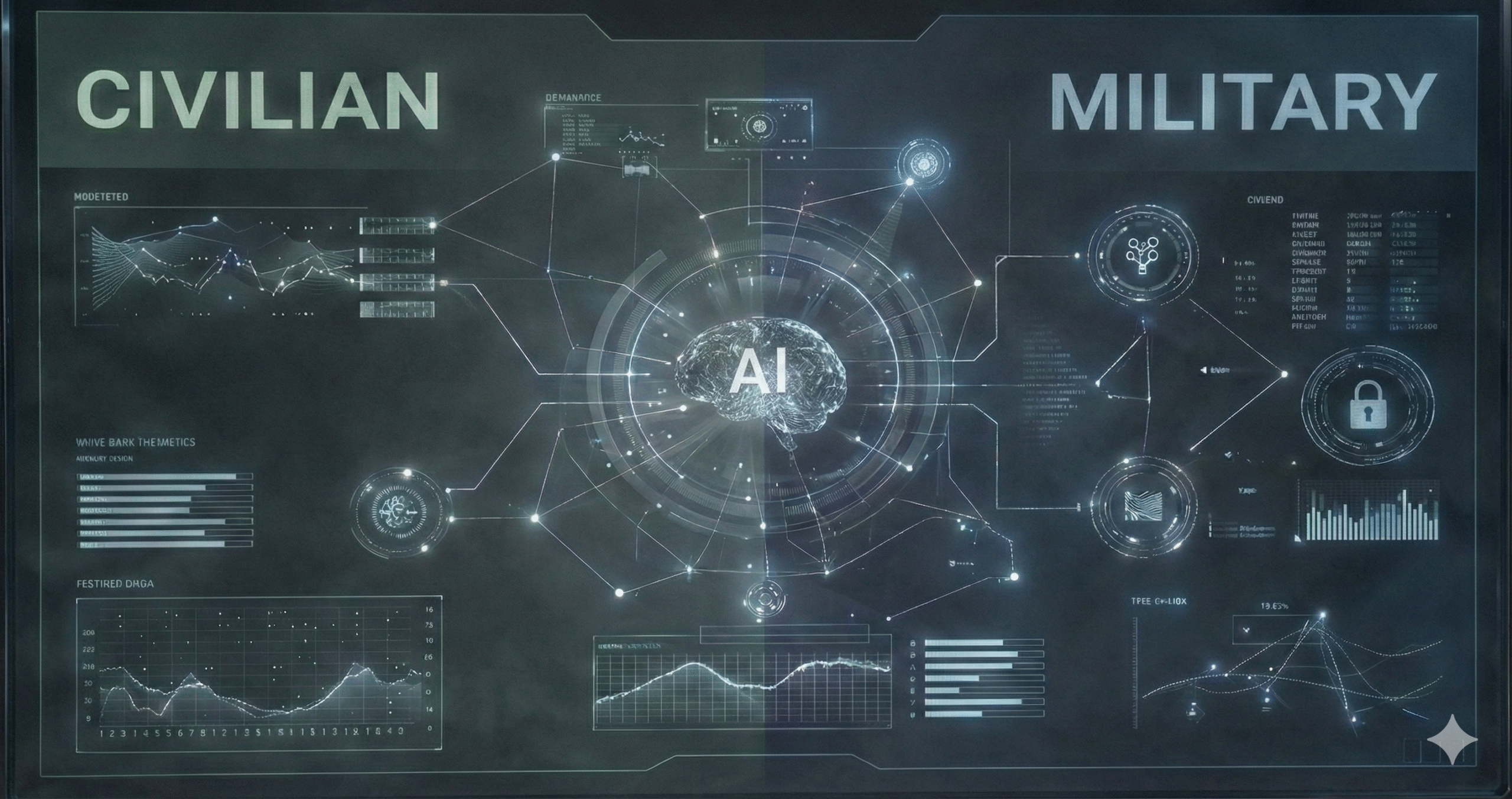
In fact, in the current debate the term dual-use is increasingly seen as too binary and not adequate to describe reality. It is difficult to identify and divide dual-use technologies into civilian and military, and this dichotomy is further complicating things within the European context (European Commission, 2024d). AI, among others, has made this categorisation less effective, as fast-moving technological change is accelerating the convergence between military and civilian applications. Thus, since these innovations can transition smoothly from one sector to another, the term omni-use may be more appropriate (Singer et al., 2025). Technological evolution is eroding traditional boundaries and putting pressure on the governance of dual-use technologies, already under strain due to the need to address ethical and regulatory concerns. The current dual-use categorisation is becoming an obstacle to progress because it fails to reflect the complexity and speed of modern innovation ecosystems (Singer et al., 2025). This classification slows innovation and inhibits public–private collaboration. Consequently, the security dilemmas that emerge stem from policy frameworks that still treat these items as distinct categories rather than as omni-use components (Kremidas-Courtney, 2025).
Additionally, the absence of a shared definition complicates compliance, with requirements differing across jurisdictions. Financing problems arise too, as programmes must consider the trade-off between the scientific value of the discovery and the related security risks which vary according to national priorities, as well as the importance of geopolitical factors (Singer et al., 2025). In fact, the nature of warfare is changing rapidly, and dual-use has become fundamental if we look at the future of our military capabilities. Critical and general-purpose technologies, together with high tech components, are intrinsically dual-use, and how they develop will depend on how warfare itself evolves, in a mutually reinforcing cycle (European Commission, 2025b).
In the early stages of development of a new technology, known as low technological readiness level (TRL), it is often unclear whether an application is primarily civilian or defence-oriented, and its dual-use potential may only become clearer later on, making regulation and risk assessment even more difficult to define (Singer et al., 2025). The TRL framework is fundamental in the dual-use discourse, as it clarifies at what point the dual-use potential is created. It is a measurement with a scale from 1 to 9, indicating the maturity level of a specific technology. At low TRLs (1-3) research is not tied to a specific application or final use. On the other hand, TRLs 4-6 mark the maturation window, the process in which prototypes are developed and tested (European Commission, 2025b). During this phase, knowledge exchange between civil and defence sectors is most effective, involving early alignment of requirements, clear certification and standardisation processes, and planned transfer of tacit knowledge such as data, models, and algorithms under the appropriate safeguards. This window offers the opportunity to respond to both civil and defence needs, while lowering costs, avoiding duplication, and allowing for component re-use and standardisation (European Commission, 2025b; European Commission, 2025c). These mid TRL stages represent the ideal phases to benefit from dual-use potential, that can then be transferred to the elaboration of both military and civilian applications. Prioritising TRLs 4-6 is strategic, as it allows to fund common prototypes and technology transfers, minimising civil–military friction, and postponing branching only when specific market needs or other requirements emerge.
In principle, the solution appears straightforward; in practice, however, it proves considerably more complex. Obtaining funding is difficult, and businesses encounter obstacles throughout the innovation cycle and the terminology dual-use, in practice, makes difference, although it may not represent reality. Funds are lacking, as well as specific R&I programmes that support new technologies in the fundamental TRL phases. For this reason, it is important to examine the programmes that the EU has put in place and understand why it is challenging for companies and SMEs to develop dual-use technologies (European Commission, 2025c).
The European dual-use ecosystem: R&I, funding and industries
The EU is known for its strong regulatory capabilities, however, tech leadership rests on capital mobilisation and competitive policies (Bonefeld-Dahl, 2025). The European Commission has recognised significant unrealised potential for transfers between civil R&D and defence applications, and President von der Leyen called for reinforcing dual-use potential and tighter coordination between EU and national programmes to reduce fragmentation in the defence sector (European Commission, 2024a, p.4; European Commission, 2024d). Accordingly, programmes and instruments have been developed to support research and funding. Historically, however, EU R&I has avoided projects with potential military application and, to this day, this reluctance persists, since the concept of technologies with dual-use potential has not yet been defined (European Commission, 2024a). Private capital is also hard to access due to ESG and reputational screens, regulatory uncertainty such as export controls and divergent national rules, and slow, fragmented defence procurement. Companies therefore turn to public funding, which still presents limitations since the EU’s fragmented and restrictive funding landscape limits dual-use and defence-related innovation (Singer et al., 2025).
The European Defence Innovation Scheme (EUDIS) was launched in 2022 as part of the European Defence Fund (EDF) to foster innovation and ease market access for newcomers. Through a business accelerator, it supports SMEs and start-ups with promising dual-use applications through financial support and dedicated infrastructure (European Commission, 2025a). EUDIS aims to bridge the gap between the civilian research portfolio, such as prototypes from Horizon Europe or the European Innovation Council (EIC), and defence capability needs by backing early dual-use prototypes (mid TRLs) that can later be configured for civilian and military use.
Meanwhile, Horizon Europe (2021–2027) is the EU’s primary research and innovation framework and focuses exclusively on civilian applications. Under the Horizon Europe Specific Programme defence research is carried out under a separate programme with distinct rules, budget and eligibility as set out in the EDF Regulation (European Commission, 2024b, p.7). Military projects are ineligible and dual-use is supported only when the stated use is civil. Within Horizon Europe, the EIC plays a fundamental role in deep-tech. EIC Transition and EIC Accelerator support critical TRL stages with potential dual-use applications while maintaining a civil focus (European Commission, 2025d). Although they lack an explicit dual-use mandate, these instruments often back start-ups in areas such as AI and quantum that may later be applied to defence. In practice, any proposal that includes a defence application is ineligible under the Horizon Europe Specific Programme, and defence stakeholders cannot access Horizon Europe capital or services for such activities, including the EIC Accelerator, and actors from the defence sector may participate only when their R&D in the project is exclusively civil (European Commission, 2024b).
These programmes illustrate that accessing funds, when not limited to civil R&I, requires strict criteria and lengthy procedures, which makes it difficult for start-ups to remain competitive (Singer et al., 2025). Companies with dual-use potential face challenges in accessing both military and civilian markets. This deadlock, known as the ‘valley of death’, is the stage at which start-ups fail or struggle to secure the initial funding needed to scale or deploy a system (European Commission, 2025b). Since many critical technologies have civilian origins yet broad defence applications, exploiting synergies is crucial. The division of R&I across the civil-defence boundary is eroding Europe’s competitive edge not only in defence but also in emerging technologies vital to today’s geopolitical landscape (European Commission, 2025c). SMEs and start-ups that switch from civil to dual-use often must scale or re-engineer late in the R&D cycle to meet defence requirements. These changes are costly, time-consuming and strategically inefficient. As the European Commission has recognised, it is therefore essential to ease newcomer access via the dual-use pathway (European Commission, 2025c).
To complete the picture, there is a series of structural impediments to the EU’s path to efficient dual-use. For example, the weak knowledge-transfer mechanisms, due to limited collaboration between civilian and military research institutions, delay the commercialisation of critical dual-use technologies. This adds to growing reluctance among universities and research institutions to engage with defence-related projects due to reputational risks and ethical considerations, thus limiting technology-transfer rates (European Commission, 2025c). Sharing research and infrastructure costs between the civil and defence sectors would allow for a more efficient use of resources, also reducing duplication (European Commission, 2025b). Within this framework, public–private partnerships, especially those between universities and industry, would increase the likelihood of successful commercialisation. This would strengthen the EU’s strategic autonomy and reduce its dependence on foreign technologies in critical areas such as cybersecurity, defence, and infrastructure (European Commission, 2025b). However, while scaling up support for R&D with dual-use potential at the EU level offers opportunities, it is still difficult to predict dual-use potential in advance, even when projects are designed for civilian or defence purposes only (European Commission, 2024b).
That is why, according to the Draghi report, it would be beneficial to create a European DARPA, the US Defence Advanced Research Projects Agency, to bring together the private sector, academia, and industry to broaden the technological and scientific frontiers beyond immediate defence considerations (Teer & Spatafora, 2025). Not only the U.S., but China too, has enhanced the instruments dedicated to technology transfers. Both of them have incorporated dual-use technology integration (DTI) governance into their innovation systems (European Commission, 2025b, p.11). In fact, it would be crucial for industries to be involved in the rule-setting process.
Finally, there is a wave of reluctance and caution in the EU, as dual-use development carries risks, including the risk of leakage, which must be assessed against a list of strategic technologies critical to economic security. This also includes the risk of the weaponisation of economic dependencies and economic coercion (European Commission, 2023). Thus, the EU focuses on protecting intellectual property, ensuring the confidentiality and integrity of sensitive research data, and creating secure project environments (European Commission, 2025c). Lastly, an issue that will be analysed in the next section is the harmonisation of regulatory concerns and procurement barriers. The need to balance security risks and export controls while supporting commercial activities represents the real challenge (Singer et al., 2025).
The openness-security trade off: trade and export controls
Export control policies are already in place for the transfer of knowledge with potential military applications (European Commission, 2025b). The Dual-Use Regulation (2021/821) governs the export, transit, and transfer of dual-use items and it forms part of the EU’s strategy for technological sovereignty, supply chain resilience, and security policy (Cyber Risk GmbH, 2025). In the current environment of rising geopolitical tensions, this regulation plays a key role in enabling the EU to restrict the flow of sensitive technologies to strategic competitors, thus preventing their potential misuse and human rights violations, while safeguarding critical EU capabilities (Cyber Risk GmbH, 2025).
The regulation provides a definition of dual-use which covers a long list of tangible and intangible items. Indeed, when required, the authorisation needs to be obtained before the item is exported. As these technologies have the potential to be used militarily amid Russia’s aggression against Ukraine and wider geopolitical tensions, some EU Member States have intensified national controls to limit the export of critical technologies (European Commission, 2023). National measures can also be introduced for dual-use items not listed in the regulation if there are public security or human rights concerns (European Commission, 2024b). For example, Germany has introduced its own list of controlled items for export to specific countries, and this is not an isolated case as national controls are constantly emerging to regulate the export of sensitive technologies outside the multilateral framework, exposing the EU to the risk of a fragmented single market (Thoms, 2024; European Commission, 2024a). As a result of the rapid development of new technologies, divergent export regulations are likely to continue emerging, further fragmenting the EU export regime (Thoms, 2024). This highlights the need for more coordinated action at EU level, since divergences between Member States could undermine the EU’s economic security (European Commission, 2023).
Furthermore, the export control system is threatened by other issues which the Regulation seeks to address. For example, there is insufficient transparency and no obligation to consult other Member States or the Commission before adopting national control lists, and there is no clear and public overview of which national controls apply where, since a Member State may adopt another State’s list and apply it without any notification requirement. Consequently, there is a risk of ‘forum shopping’, as national controls bind only extra-EU exports, not intra-EU trade, thereby undercutting effectiveness and placing firms in stricter jurisdictions within the EU at a competitive disadvantage (European Commission, 2024a, p. 9). These internal shortcomings are compounded by the absence of a single European voice in international fora, undermining the EU’s credibility to operate as a cohesive geopolitical actor alongside competitors such as the U.S. and China (European Commission, 2024a). This underscores the importance of coordinating new National Control Lists introduced by Member States to avoid a patchwork of measures (European Commission, 2024a).
Export controls play a fundamental role in protecting the EU’s economic security and upholding non-proliferation by restricting access to dual-use goods and technologies, particularly for sensitive destinations (Machiko, 2018). However, trade restrictions involve trade-offs. For example, applying a catch-all approach to all destinations could harm industry and impose excessive regulatory costs, thereby limiting the benefits of free trade (Machiko, 2018). Conversely, destination-based controls target areas of risk, helping to prevent misuse while avoiding placing an undue burden on exporters. However, these targeted regimes require clear rules, adequate administrative capacity, and consistent risk assessment to remain effective (Machiko, 2018). At the same time, cross-border flows of materials, components, and knowledge are integral to market economies, technological progress, and broader socio-economic development. Restricting the transfer of dual-use items too severely can therefore reduce the social benefits of innovation in both exporting and importing countries, hindering growth and the diffusion of beneficial technologies (Machiko, 2018). Thus, effective export control policies must strike a balance, being stringent enough to prevent misuse yet flexible enough to preserve the economic and societal benefits of open but governed technology exchange (Machiko, 2018).
As shown, compliance with export controls is a real challenge in the EU dual-use domain. Once again, the effects can be seen on SMEs and startups which do not qualify for basic scientific-research exemptions and face heavy regulatory demands, while lacking the necessary export-control expertise to avoid losing the advantage they could have in reaching the market in time (European Commission, 2025c). Also, even though civilian markets offer greater potential to attract R&I funding, under the current legal and regulatory conditions, dual-use pathways can still entail higher costs, longer time-to-market, and slower innovation because firms must satisfy distinct civil-market requirements and more extensive defence standards (European Commission, 2025c).
Further complications arise from supply-chain constraints, such as scarcity of high-end enabling components, which hinders the development of European technology and highlights the need for secure supply chains, not only for dual-use purposes, but to ensure the EU’s economic security (European Commission, 2025c). Although research may have legitimate civil objectives, unintended transfers or illicit end uses can still lead to military applications or harm human rights and public security. Hence, trade controls are fundamental in regulating such transfers and mitigating these risks (European Commission, 2025c). Although dual-use transfers account for only a small proportion of extra-EU exports, around 2 per Cent at the beginning of 2025, they require close monitoring. Accurate item classification is therefore essential for determining licensing requirements, and early TRL assessments can help identify export-control issues from the outset (European Commission, 2025c). Finally, it is fundamental for exporters to assess whether their items and projects fall under the dual-use or the military export-control regulations, as these tend to be more stringent and fall under Member States’ legislation (European Commission, 2025c).
Concluding remarks
As shown throughout the paper, the EU is currently experiencing a dual crisis involving increased security threats and declining competitiveness. However, increased defence spending could address both issues if stronger links were established between the defence sector and civilian R&I. In fact, on one hand, history shows that defence is a driver of technological progress; on the other, civilian research is crucial to develop military applications. As the European Commission has already underlined, the challenge lies in strengthening and leveraging these synergies, while also reducing risks and avoiding over-securitisation, which could hinder trade openness and investment attraction. Thus, the EU needs to provide more support for dual-use R&D and facilitate spillovers from defence-funded technologies into civilian markets. During this period of rapid technological change, well-designed dual-use policies could ensure alignment between security and ethical considerations.
The Commission has already outlined a way forward and is well aware of the potential and shortcomings related to dual-use. It recommends integrating dual-use research into EU R&I policy and adapting the next framework programme to explicitly address dual use, accelerating knowledge transfer between civil, military, and dual-use domains. The EU should scale up its spin-in and spin-off models, incorporating civilian innovations into defence and commercialising defence-funded breakthroughs in civilian markets. This can be achieved through public–private partnerships, targeted funding and innovation hubs and accelerators (European Commission, 2025c).
Finally, the EU must find its own way forward with regard to dual-use. The question is no longer if or when, but how. The EU has the funds and the means, and the Commission already has proposals and a clear sense of what must be done. The test now lies in implementation and follow-through. Will Europe be able to act with purpose and coordination, or will it become entangled in bureaucracy?
Bibliography
- Bonefeld-Dahl, C. (2025, July 10). Europe’s sweet spot: Dual-use tech for security and sovereignty. Euractiv.https://www.euractiv.com/opinion/europes-sweet-spot-dual-use-tech-for-security-and-sovereignty/
- Cutts, E. (2025, December 8). Europe mulls boosting military R&D with civilian science funding. Science. https://www.science.org/content/article/europe-mulls-boosting-military-r-d-civilian-science-funding
- Cyber Risk GmbH. (2025, October). EU Biotech Act | Understanding the Dual-Use and Security Concerns. Cyber Risk GmbH. https://www.eu-biotech-act.com/
- European Commission. Directorate General for Internal Market, Industry, Entrepreneurship and SMEs. (2017). Dual use technology in the EU: Helping SMEs bring innovation to market. Publications Office. https://data.europa.eu/doi/10.2873/14116
- European Commission & High Representative of the Union for Foreign Affairs and Security Policy. (2023, June). Joint Communication to the European Parliament, the European Council and the Council on “European Economic Security Strategy.” https://doi.org/10.1093/law-oeeul/e66.013.66
- European Commission. (January 2024a). White Paper on Export Controls. Press Corner Documents. https://circabc.europa.eu/ui/group/aac710a0-4eb3-493e-a12a-e988b442a72a/library/a44df99c-18d2-49df-950d-4d48f08ea76f/details?download=true
- European Commission. (January 2024b). White Paper on options for enhancing support for research and development involving technologies with dual-use potential. https://research-and-innovation.ec.europa.eu/document/download/7ae11ca9-9ff5-4d0f-a097-86a719ed6892_en?filename=ec_rtd_white-paper-dual-use-potential.pdf
- European Commission. (March 2024c). EU Dual-use Export Controls: Overview and recent developments. https://www.bis.doc.gov/index.php/documents/compliance-training/3491-international-cooperation-and-export-controls-eu/file
- European Commission. Directorate General for Research and Innovation. (September 2024d). Align, act, accelerate: Research, technology and innovation to boost European competitiveness. Publications Office. https://data.europa.eu/doi/10.2777/9106236
- European Commission. (March 2025a). EU Defence Innovation Scheme (EUDIS). https://eudis.europa.eu/index_en
- European Commission. Directorate General for Research and Innovation. (April 2025b). Making the most of EU research and innovation investments: Rethinking dual use.: Vol. ESIR. Publications Office. https://data.europa.eu/doi/10.2777/6637451
- European Commission. Directorate General for Research and Innovation. (June 2025c). Unlocking the potential of dual-use research and innovation. Publications Office. https://data.europa.eu/doi/10.2777/5771805
- European Commission. (October 2025d). EIC Accelerator—European Innovation Council—European Commission. https://eic.ec.europa.eu/eic-funding-opportunities/eic-accelerator_en
- Francica, E. (2025, September 23). Parliament divided over dual use in next EU research programme. Science|Business. https://sciencebusiness.net/news/dual-use/parliament-divided-over-dual-use-next-eu-research-programme
- Goddard, S. E. (2025, April 22). The Rise and Fall of Great-Power Competition. Foreign Affairs, 104(3).https://www.foreignaffairs.com/united-states/trump-rise-and-fall-great-power-competition
- Kanetake, M. (2018). Balancing Innovation, Development, and Security: Dual-Use Concepts in Export Control Laws. In N. Craik, C. S. G. Jefferies, S. L. Seck, & T. Stephens (Eds.), Global Environmental Change and Innovation in International Law (1st ed., pp. 180–200). Cambridge University Press. https://doi.org/10.1017/9781108526081.011
- Kremidas, C. (2025, January 10). From Dual-Use to Omni-Use: Securing Europe’s Future. European Policy Centre. https://www.epc.eu/publication/from-dual-use-to-omni-use-securing-europes-future/
- NATO. (2025, June 25). Emerging and disruptive technologies. NATO. https://www.nato.int/cps/en/natohq/topics_184303.htm
- Singer, J. R., Mueller, E. F., & Kraus, R. (2025). Dual-Use or Omni-Use? Rethinking Technology in a Borderless World(SSRN Scholarly Paper No. 5185227). Social Science Research Network. https://doi.org/10.2139/ssrn.5185227
- Steinberg, F., & Wolff, G. (2023). Dealing with Europe’s economic (in-)security. Global Policy, 15(1), 183–192. https://doi.org/10.1111/1758-5899.13303
- Teer, J., & Spatafora, G. (2025, July 2). When stars align: Leveraging European defence budgets to drive a dual-use tech boom. European Union Institute for Security Studies. https://www.iss.europa.eu/publications/briefs/when-stars-align-leveraging-european-defence-budgets-drive-dual-use-tech-boom
- Thoms, A. (2024, June 20). Export controls in the European Union. Global Investigations Review. https://globalinvestigationsreview.com/guide/the-guide-sanctions-archived/fifth-edition/article/export-controls-in-the-european-union