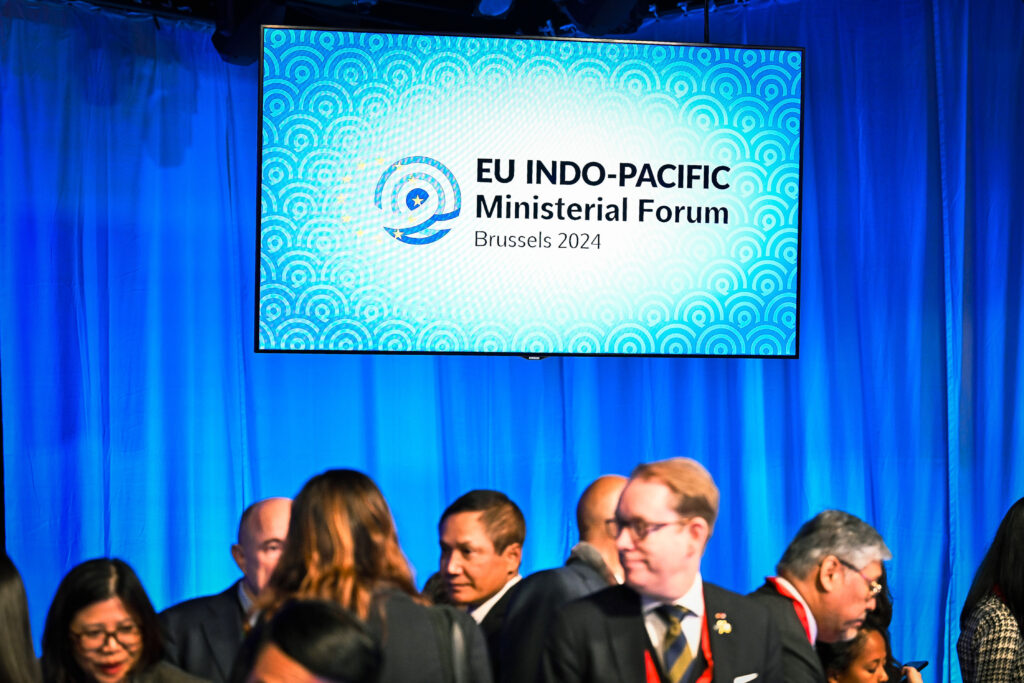
The Indo-Pacific has become central to the European Union’s economic security and geopolitical future, as its trade routes and defence-industrial supply chains are increasingly shaped by Sino–US rivalry. Therefore, the EU has adopted an Indo-Pacific strategy and has expanded its presence. However, a gap persists between ambition and capacity. EU-level initiatives remain largely limited to connectivity, capacity building, and coordination, while meaningful security engagement has been driven primarily by national initiatives. The paper argues that France, as the only European resident power in the Indo-Pacific, illustrates both the potential and the limit of a nationally driven approach.
Disclaimer
For years, the Indo-Pacific region has been at the centre of the redefinition of power dynamics, and its growing importance is related to economic, political, and security factors. Home to some of the world’s fastest-growing economies, the Indo-Pacific is one of the European Union’s top trading partners and one of its largest export markets (Borrell, 2021; Grare & Reuter, 2021; Keßler, 2024). As the Indo-Pacific’s sea routes connect Europe with the rest of the world, maritime security and the protection of sea lanes are essential for safeguarding EU trade (Pajon, 2025b). Consequently, this calls for an intensification of the EU security engagement in the region, which takes into account defence and political considerations (Borrell, 2021). Indeed, this is also related to China’s expanding role in the Indo-Pacific, framed by the strategic rivalry between the latter and the United States (U.S.), which indirectly draws in the EU. In fact, its economic security and geopolitical future is becoming increasingly intertwined with the evolving dynamics of Sino-U.S. rivalry in the region (Grare & Reuter, 2021; Pugliese, 2023).
Within this context, the Council of the European Union has called for increased efforts in the European countries to address security challenges, while stressing the need for enhanced cooperation with Indo-Pacific partners and organisations (Council of the European Union, 2025). Efforts became concrete when the EU released its Indo-Pacific strategy in 2021. However, four years after its adoption, those efforts have fallen short of expectations. This is partly because the EU mostly acted through bilateral relationships (although these have often been successful and more significant) rather than as a united front (Smith, 2025). Thus, while the EU strives for a more significant presence in the Indo-Pacific, moving to a multilateral and more targeted approach is necessary.
This paper examines how and why the EU should shift from bilateral engagements to a more coordinated, EU-level approach to protect trade, supply chains, and critical maritime infrastructure. First, it outlines the actions taken by the EU, and then uses France as a case study, focusing on its role as a leading security actor in the region. Finally, the paper will explain why moving towards EU-level multilateralism is necessary to strengthen its influence and position it as a global player.
Between ambition and reality: the EU’s Indo-Pacific engagement
Since Russia’s invasion of Ukraine in 2022, European Member States and Asian countries have increasingly recognised their growing interdependence as developments in the Indo-Pacific have direct consequences on European security. Both Russia and China represent a source of concern for the EU. Firstly, China is supporting Russia by supplying military equipment to be used in the war in Ukraine, and most dual-use exports originate from there. Secondly, Russia is pursuing a military programme in China for the production of long-range attack drones (Gers & Matlé, 2025). Therefore, China’s threat is twofold: it indirectly threatens Europe by supporting Russia, and directly by disrupting supply chains, particularly for semiconductors. This underlines the need for the EU to reconsider its economic and technological engagement with China, and consequently, with the Indo-Pacific countries (Schreer, 2025).
The Indo-Pacific countries represent an area of crucial economic and technological importance to European countries, especially now that the EU seeks to strengthen its own security posture mostly for two reasons. The first is to ensure the flow of goods through Asia’s trade routes. However, this is not only to guarantee the passage of commercial vessels, as EU countries often focus on the security of sea lines of communication. There is also a need to protect freedom of navigation, partners’ exclusive economic zones, undersea data cables and fisheries (Grare & Reuter, 2021). The second reason represents the growing defence-industrial market. In fact, increasing doubts about the reliability of the U.S. as a defence partner and the consequent rise of EU defence spending call for the Union to deepen its engagement. Arms cooperation with Indo-Pacific partners could both reinforce Europe’s defence-industrial base and support regional stability by strengthening military capabilities and regional deterrence (Schreer, 2025). At the moment, Indonesia and Singapore represent the most open markets for European suppliers (Schreer, 2025). Japan is also willing to deepen its defence-industrial ties with the EU, while India though still heavily dependent on Russia for armaments has faced delays in deliveries. Thus, by acknowledging its difficulties in developing a defence-industrial base, India has become more open to alternative suppliers, such as European manufacturers (Schreer, 2025). However, it remains difficult for the EU to increase its market share in the region.
To address these issues, the EU has taken concrete policy steps over the years, but will its ambitions keep up with actual defence engagement? The first of these initiatives was the 2016 EU Global Strategy (EUGS), which marked the beginning of a more strategic approach to Asia by emphasising its importance for trade and connectivity. This was followed by the 2018 Connecting Europe and Asia strategy, which focused on rules-based infrastructures and trade (Pugliese, 2023). The EU-Asia connectivity strategy was widely seen as an attempt to offer countries in the region an alternative to Beijing’s Belt and Road Initiative. However, the broad scope of what can be considered as connectivity has led individual Member States to pursue their own priorities (Grare & Reuter, 2021). Then, in 2021, the Council of the European Union approved the EU Strategy for Cooperation in the Indo-Pacific to increase the EU’s political, economic, and military presence in the region (Pugliese, 2023). The strategy aimed to establish a naval presence for joint exercises and enhance information sharing in the region (Schreer, 2025). It also incorporated military elements, such as the deployment of European warships and the extension of the EU’s Critical Maritime Routes in the Indian Ocean (CRIMARIO) capacity-building project to the Southern Pacific, to enhance maritime security and intelligence sharing (Reiterer, 2023; Bouffaron & Blandin, 2025).
CRIMARIO underlines the importance of maritime cooperation, which constitutes one of the pillars of the EU-ASEAN (Association of Southeast Asian Nations) strategic partnership. The EU participates in the ASEAN Regional Forum and the East Asia Summit, engaging regularly through these platforms as well as through security dialogues with individual partners such as Japan (Keßler, 2024). In this regard, Ambassador Sasae Kenichiro stated that Japan shares common values with the EU countries and it would be beneficial to increase security cooperation (Schreer, 2025). This shows that the Indo-Pacific partners are interested in deepening their engagement with the Union, and the EU countries, for their part, have participated in naval exercises. However, EU-led missions and operations have shown a mismatch between the allocation of resources in the region and its most pressing security challenges (Keßler, 2024). EU countries have stepped up their presence, but deployments have taken place predominantly under national flags, making it difficult for the EU to establish a cohesive maritime presence (Schreer, 2025).
The analysis has shown that the EU’s approach to the Indo-Pacific is marked by weaknesses and contradictions. The strategies adopted have not provided an adequate framework for the EU to play a truly strategic role, as they are too limited in scope and lack a more strategic geopolitical perspective (Garcia Cantalapiedra, 2021). Thus, despite aspiring to be a global player, the EU’s reputation has been undermined by a paradox. While East Asia has become an economic powerhouse and the EU as one of its main economic partners, Asian countries primarily measure power and influence in military terms; thus, the EU’s insufficient military efforts in the region undermine its credibility (Reiterer, 2023).
If we compare the EU’s efforts with those of France, the latter stands out as the main European security actor in the Indo-Pacific. France has traditionally maintained a military presence across the region and other European powers, such as Germany, the Netherlands and Italy, have gradually increased their deployments as well. Since European engagement has been driven mostly by national initiatives, it remains to be seen whether the EU will be able to play a distinctive role in the security domain, following France’s example (Schreer, 2025; Blandin & Bouffaron, 2025).
The economic measures on which the EU relies on, such as free trade agreements (FTAs), supply-chain diversification, and programmes on digital cooperation and connectivity, have been largely effective, whereas its security instruments remain mostly limited to capacity building and the coordination of Member States’ assets (Sciences Po, 2021). As a result, EU-level approaches have provided only a partial and sometimes incoherent framework, while bilateral initiatives by European states have generally been more effective. The following analysis takes this as its point of departure, examining France’s national approach, its core strengths, and how these could be applied at the EU level.
France: resident power and EU forerunner in the Indo-Pacific
– Strategic posture and regional role
France released its Indo-Pacific strategy in 2018 and decided to pursue its objectives by dividing them into four pillars: security, economy, multilateralism, and climate change. France’s engagement in the region is comparable to no other country through its membership in several regional organisations, the Asian Development Bank (ADB), and through a number of regional partnerships (Abbondanza & Grgic, 2025). Of all the European powers, France has articulated its security interests in the Indo-Pacific most clearly, given its sovereignty interests in the region, as its overseas territories grant France control over the world’s second-largest exclusive economic zone (EEZ) (Schreer, 2025).
In 2019, the document France and Security in the Indo-Pacific, published by the Ministry of the Armed Forces, reasserted France’s status as a resident power in the region. It defined Indo-Pacific security as a strategic challenge and confirmed the commitment to regional stability, including through a substantial military presence. In 2021, the France’s Partnerships in the Indo-Pacific document was released, and it focused on Franco-Australian security cooperation in the context of the submarine partnership (Schreer, 2025).Then, in 2022, the French government adopted its National Strategic Review, which explicitly listed China among the “main areas of antagonism” and identified “the growing Sino-Russian cooperation as a source of concern” (Schreer, 2025, p. 15).
France’s economic and geopolitical stakes in the Indo-Pacific are higher compared to other EU countries, as it has nearly two million citizens in the region. For this reason, it is integrating its overseas territories as fundamental stakeholders in its strategy while also trying to shape the EU’s Indo-Pacific engagement. In this sense, France’s approach seeks to move away from bloc-based geopolitics, distancing itself from a US-China confrontation narrative and promoting sovereignty partnerships that respect Indo-Pacific countries’ sovereignty. Because of this, the strategy works through a project-by-project cooperation logic, thus focusing on concrete needs and specific thematic areas, such as naval cooperation or industrial agreements (Bouffaron & Blandin, 2025).
However, President Emmanuel Macron’s stance on China and the Indo-Pacific region remains ambiguous. During his visit to China in 2023, he suggested that Europe should not simply follow America in the event of a conflict with China, and he questioned what role Europe could play, for example, in a crisis with Taiwan. Nevertheless, he has pushed for EU tariffs on Chinese electric vehicles (Evs), showcasing his commitment to defending France’s economic interests (Schreer, 2025). Despite doubts over Europe’s capacity to remain engaged in the Indo-Pacific, Macron emphasised France’s close connections with the region in his keynote addressed at the 22nd IISS Shangri-La Dialogue, presenting France as a key player in both Europe and the Indo-Pacific, while calling for a new special relationship between the two regions (Baruah & Nouwens, 2025).
– Economic and industrial relations
Industrial cooperation represents the most important aspect of France’s economic presence in the region. Bilateral defence agreements with key countries, such as India and Indonesia, have further developed, including the sale of Rafale fighter jets, joint naval patrols, and submarine projects. These initiatives highlight both a growing strategic convergence and a long-term industrial interdependence. For example, India has become a key destination for French arms exports, with France emerging as one of India’s primary suppliers of advanced military equipment, particularly in the air and naval domains. Similarly, arrangements with Japan have enhanced maritime surveillance and further embedded French industry within the region’s security architecture (Bouffaron & Blandin, 2025).
Consequently, Indo-Pacific governments increasingly view France as a reliable provider of advanced capabilities, helping them reduce their reliance on any single power. France’s major defence companies, such as Dassault Aviation, Naval Group, and Thales, are therefore key instruments in strengthening the EU’s influence (Bouffaron & Blandin, 2025). In this sense, French industrial engagement is reinforcing foreign and security policy, serving as a channel through which broader European ambitions in the Indo-Pacific can be realised.
– Maritime security and military deployments
Given its status as a resident power, France has developed advanced and far-reaching military capabilities. It maintains military bases in Djibouti, the United Arab Emirates (UAE), Mayotte, La Réunion, New Caledonia and French Polynesia, giving it a broad geographic presence in the region (Abbondanza & Grgic, 2025). French personnel are permanently stationed in New Caledonia and French Polynesia, and the tasks covered range from maritime surveillance to civil security (Pajon, 2025a). To monitor its maritime territories, France works with Australia and New Zealand on surveillance missions and to combat illegal fishing. It also takes part in joint exercises such as the Tautai and Kurukuro operations organised by the Pacific Island Forum Fisheries Agency (FFA) (Pajon, 2025a).
France’s Indo-Pacific approach is characterised by its comprehensiveness. In fact, France maintains a blue-water navy capable of carrying out sustained operations far from its own shores. Second only to the U.S. Navy, it possesses an ocean-going fleet, a nuclear-powered aircraft carrier and nuclear submarines. These assets give France an advantage in the region’s maritime environment compared to other European countries and have enabled it to make substantial deployments for decades, whether independently or with allies. This includes participation in passing exercises (PASSEXs), freedom of overflight operations, and freedom of navigation operations (FONOPs), often involving the Charles de Gaulle aircraft carrier, mostly in the South China Sea.
Furthermore, France has led and participated in numerous military exercises with regional partners, including the multilateral La Pérouse naval drills, the Varuna and Garuda exercises with India, and the Pitch Black air combat exercise in Australia, as well as the Pegase air and naval deployments, and the Jeanne d’Arc maritime security mission (Abbondanza & Grgic, 2025; Schreer, 2025). These initiatives are aimed at enhancing interoperability and capacity building. For this reason, most Indo-Pacific nations acknowledge France’s contribution to regional stability and to the strengthening of the Pacific Island countries’ maritime capacities (Bouffaron & Blandin, 2025; Pajon, 2025a).
Not only its personnel but also its maritime governance framework support France’s overseas role and this approach could be a model for countries in the region with limited capabilities. Instead of relying on a separate coast guard service, France employs a multi-agency approach known as the Coast Guard Function within its broader State Action at Sea (Action de l’État en mer, AEM) framework. It involves a coordinated effort among various government agencies that collectively handle coast guard responsibilities with the Secretary General for the Sea ultimately overseeing these activities (Pajon, 2025a).
However, France’s role as a leading example for the EU also highlights shortcomings. Tensions persist between France and its overseas territories, as these relationships continue to be shaped by colonial legacies (Pajon, 2025a). Another factor to take into account is France’s limited resources compared to other regional powers, such as Australia, as the effectiveness of its strategy depends on close coordination with these partners. This limitation underscores why national initiatives alone are insufficient. A steady partnership with Australia and India, for example, would represent a key pillar not only for France’s engagement, but also for a broader European engagement in the Indo-Pacific (Pajon, 2025a; Grare & Reuter, 2021).
The limits of European engagement
EU Member States hold different perspectives on the Indo-Pacific matters. Despite the region’s growing economic and political importance, indifference towards it still prevails in many EU countries, but since there seems to be no real opposition, it should be possible for the EU to adopt a more decisive stance (Grare & Reuter, 2021). Also, divergences among MSs mainly arise from differing views of China. Trade and economic interests have traditionally prevailed in some countries, such as in Germany, whereas for others, human rights considerations have been more central (Keßler, 2024; Pugliese, 2023). For this reason, the EU countries have adopted national Indo-Pacific strategies, pushing the Union towards a more decisive approach. However, their stance on China remained unclear and further highlighted the fragmented landscape.
This fragmentation is particularly evident in the security domain where the gap between France and other Member States is significant. France remains central to shaping the EU’s strategy and represents a leading example of what coordinated European efforts could achieve. Its overseas territories provide a base for sustaining and expanding Europe’s influence, serving as logistical hubs for deeper engagement in the region (Bouffaron & Blandin, 2025). In contrast, for most EU countries, lacking such logistical hubs means that a regular deployment of naval assets in the region would be difficult to sustain financially (Pugliese, 2023). Most MSs lack the resources needed to engage meaningfully in areas such as in maritime security and building these capabilities would take years of investment.
This capability gap leades to a credibility issue. The absence of a unified narrative weakens Europe’s voice, as it shows fragmentation in the eyes of Indo-Pacific partners. If Europe does not set out clear goals, such as pushing back against coercion in the South China Sea or helping partners strengthen their navies, its efforts will not look like serious commitments. To bridge this gap, the EU should adopt a more targeted approach. EU countries should concentrate on specialised areas where demand is high and where they have visible expertise, such as fisheries management (Grare & Reuter, 2021). This suggests that a meaningful European presence in the Indo-Pacific could be structured around differentiated roles and specialisations among Member States, anchored in a unified European narrative. Such an approach would help avoid the EU falling short of its commitments and prevent partners from seeing its engagement as merely symbolic (Yu, 2025).
Furthermore, strategic clarity requires closer alignment with regional powers. Europe could and should discuss its forthcoming strategy with key Indo-Pacific partners, such as Australia, India and Japan. In fact, these countries are more economically dependent on China than the EU and face greater security risks due to geographical proximity. It is therefore logical to involve them in discussions on how the forthcoming EU strategy should be implemented (Grare & Reuter, 2021).
Finally, a softer type of contribution to regional security could be another step, as it is illustrated by the project Enhancing Security Cooperation in and with Asia (ESIWA). The EU has partly funded the French and German development agencies to promote this four-year initiative with a €15 million budget, which is considered a practical tool to implement the 2021 EU’s Indo-Pacific strategy (Pugliese, 2023). The project, still in its early stages, aims to strengthen the capabilities of several Southeast Asian countries and India by improving the monitoring of activities at sea, also benefitting European companies. However, even with such practical tools, European diplomats suggest that coordination between different donors and recipient countries is difficult, as interests do not necessarily align, and there is a possibility of duplication of projects and initiatives among like-minded partners (Pugliese, 2023).
Concluding remarks
The Indo-Pacific region has become pivotal to the EU’s economic security and geopolitical future. Its trade routes, technological supply chains and defence-industrial opportunities are directly linked to Europe’s resilience and security. At the same time, increasing Sino-US rivalry is also impacting on the strategic environment in which the EU must operate. In response, Europe has developed an Indo-Pacific strategy and increased its presence in the region. However, there is still a clear discrepancy between its ambitions and its actual capabilities. A lack of coordination between Member States, limited military capabilities, and a top-down approach have caused European engagement to appear more symbolic than substantive to regional partners.
France’s experience shows both what is possible to achieve and where the limits lie. As a resident power with overseas territories, a blue-water navy, and extensive industrial and security partnerships, France exemplifies how the EU can maintain a sustained presence, enhance maritime security, and foster regional capacity development. However, its limited resources highlight that no single state can fulfil Europe’s Indo-Pacific role alone. Rather than relying on national initiatives, the EU should use France as an example to foster an EU-level approach combining differentiated roles and specialisations among Member States with a coherent strategic narrative.
Finally, the EU must broaden its engagement beyond individual state efforts and strengthen its structured cooperation with key Indo-Pacific partners, including Australia, India, Japan, ASEAN and Pacific Island countries. A more collaborative and maritime-focused strategy would strengthen the EU’s credibility, as the Indo-Pacific region is too strategically important for Europe to treat as a peripheral theatre.
Bibliography
- Abbondanza, G., & Grgic, G. (2025). Europe’s Indo-Pacific approaches: Economy, norms, and security. In: Europe’s Indo-Pacific pivot (pp. 43–79). Palgrave Macmillan. https://doi.org/10.1007/978-981-95-0273-8_2
- Baruah, D., & Nouwens, V. (2025, July 29). Europe and the Indo-Pacific: New opportunities for a ‘special relationship.’IISS. https://www.iiss.org/online-analysis/online-analysis/2025/07/europe-and-the-indo-pacific-new-opportunities-for-a-special-relationship/
- Borrell, J. (2021, March 12). The EU needs a strategic approach for the Indo-Pacific. European External Action Service.https://www.eeas.europa.eu/eeas/eu-needs-strategic-approach-indo-pacific_en
- Bouffaron, P., & Blandin, B. (2025, April 8). The future of European influence in the Indo-Pacific. Fondation Robert Schuman. https://www.robert-schuman.eu/en/european-issues/786-the-future-of-european-influence-in-the-indo-pacific
- Council of the European Union. (2025, October 20). Council conclusions on the implementation of the EU strategy for cooperation in the Indo-Pacific [Press release]. https://data.consilium.europa.eu/doc/document/ST-14071-2025-INIT/en/pdf
- Garcia Cantalapiedra, D. (2021). What role for EU in the Indo-Pacific? EU power projection, Asian-European security cooperation and the future of the multilateral liberal international order. Asia-Pacific Journal of EU Studies, 18(3), 37–53.
https://www.researchgate.net/publication/348650107_What_Role_for_EU_in_the_Indo-Pacific_EU_Power_Projection_Asian-European_Security_Cooperation_and_the_Future_of_the_Multilateral_Liberal_International_Order_1 - Gers, H., & Matlé, A. (2025, September 9). In the same boat: Security challenges in the Euro-Atlantic and Indo-Pacific. German Council on Foreign Relations. https://dgap.org/en/research/publications/same-boat-security-challenges-euro-atlantic-and-indo-pacific
- Grare, F., & Reuter, M. (2021, September 13). Moving closer: European views of the Indo-Pacific. European Council on Foreign Relations. https://ecfr.eu/special/moving-closer-european-views-of-the-indo-pacific/
- Keßler, C. (2024, January 8). A sea of troubles: Addressing the EU’s incoherence on the Indo-Pacific. Centre for European Reform. https://www.cer.eu/insights/sea-troubles-eus-indo-pacific
- Pajon, C. (2025a, February 20). France’s Contributions to Pacific maritime governance. French Institute of International Relations. http://www.ifri.org/en/external-publications/frances-contributions-pacific-maritime-governance
- Pajon, C. (2025b, October 17). Expanding SPDMM as a pivotal institution in the Pacific – A French perspective. French Institute of International Relations. http://www.ifri.org/en/external-articles/external-publications/expanding-spdmm-pivotal-institution-pacific-french
- Pugliese, G. (2023). The European Union’s security intervention in the Indo-Pacific: Between multilateralism and mercantile interests. Journal of Intervention and Statebuilding, 17(1), 76–98. https://doi.org/10.1080/17502977.2022.2118425
- Reiterer, M. (2023). The European Union in Asia and the Indo-Pacific: International cooperation in the era of great transformtion and mounting security challenges. (Collection débats et documents). Fondation Jean Monnet Pour l’Europe. https://jean-monnet.ch/wp-content/uploads/2023/12/23-12-eu-asia-indopacific-m-reiterer-cdd-31.pdf
- Schreer, B. (2025, June 4). More or Less? European defence engagement in the Indo-Pacific in the Second Trump administration. International Institue for Strategic Studies. https://www.iiss.org/research-paper/2025/06/more-or-less-european-defence-engagement-in-the-indo-pacific-in-the-second-trump-administration/
- SciencesPo. (2021). Indo-Pacific seen from European Union 2021. Observatory Indo-Pacific. https://www.sciencespo.fr/observatory-indo-pacific/indo-pacific-strategies/european-union/
- Smith, N. (2025, July 10). Re-thinking the EU’s Indo-Pacific strategy: A Bottom-up approach. Georgetown Journal of International Affairs. https://gjia.georgetown.edu/2025/07/10/re-thinking-the-eus-indo-pacific-strategy-a-bottom-up-approach/
- Yu, J. (2025, October 9). Op-ed: Europe’s Indo-Pacific ambitions need a coherent strategy. The Parliament.https://www.theparliamentmagazine.eu/news/article/oped-europes-indopacific-ambitions-need-a-coherent-strategy
Leave a Reply